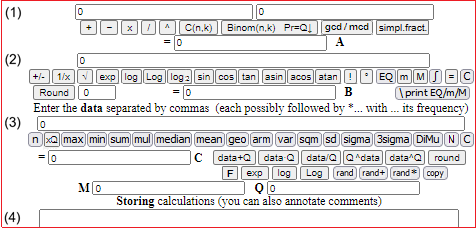
+      -      x      /      ^      C(nk)      Binom(nk)      gcd/mcd       simpl.fract.       A  
  +/-      1/x      √      exp / log / Log / log2      sin cos tan      asin acos atan      !      °      EQ      m M           =  
  Round      B  
  n      xQ      max      min      sum      mul      median      mean      geo      arm  
  var      sqm      sd      sigma      3sigma      DiMu       N       C  
  data+Q      data·Q      data/Q       Q^data      data^Q      round  
  exp      log      Log      rand      rand+      rand*      copy  
  C      M      Q  
[ 5 ]   [ 1/3 ]   [+]
  5.333333333333333
[ 5 ]   [ 1/3 ]   [-]
  4.666666666666667
[ pow(2,3) ]   [ 5 ]   [x]
  40
[ 100 ]   [ 7 ]   [/]
  14.285714285714286
[ 9 ]   [ 3/2 ]   [^]
  27
[ 6 ]   [ 3 ]   [C(n,k)]
  20
[ 6 ]   [ 2 ]   [Binom(n,k) Pr=Q]   [0.125] in Q
  0.13738632202148438
Es:: La probabilità con cui un certo veleno uccide un topo è 78%. Usandolo su un gruppo di 5 topi, con che probabilità ne muoiono 2?
Metto sopra A  [5] [2]   in Q  0.78, ottengo  Binom(5,2) = 0.06478243199999999 → 6.48%
La probabilità che ne muoiano al più 2  ossia  Binom(5,0)+Binom(5,1)+Binom(5,2):
In [M] metto (da zero a 2) e ottengo  0.07443377919999998 → 7.44%
[gcd / mcd]   →  [DiMu]
[ 48 ]   [ 54 ]   simpl.fract.
  48 / 54 = 8 / 9
In  A a result appears or you can write a number; then you can use A as input in other boxes

[ 5 ]   [+/-]
  -5
[ 5 ]   [1/x]
  0.2
[ 25 ]   [√]
  5
[ 10 ]   [exp]    22026.465794806718
[ NE ]   [log]    1
[ 10 ]   [Log]    1
[ 8 ]   [log2]    3
[ PI/4 ]   [sin]    0.7071067811865475
[ 45 * PI/180 ]   [cos]    0.7071067811865475
[ 45 * PI/180 ]   [tan]    0.999... → 1
[ 45 ]  [°]  →  0.7853981633974483 (→B);   [ B ]   [tan]    1
[ 1 ]   [asin]    1.5707963267948966 → 90^
[ 1 ]   [acos]    0 → 0^
[ 1 ]   [atan]    0.7853981633974483 → 45^
[ 15 ]   [!]
  1307674368000
[ 180 ]   [°]
  3.141592653589793
[ Q*Q-2 ]   [EQ]
  1  1.3,   0.75  1.5,   1.25  1.5, ...,  1.414213562373095 1.4142135623730951, ...
Soluzione di sin(x)+cos(x) = 1/2, 1 < x < 3: metto  sin(Q)+cos(Q)-1/2  nella finestra sotto A,  1 e 3 in quelle sopra ad A e schiaccio ripetutamente [EQ]
In Q ottengo: 1.5, 1.75, 1.875,..., 1.994828224182129, se mi fermo qui: dif= 0.0000019073... (indeterminazione), F(Q)= -0.000001765687...
Se mi fermo a Q=1.9948273662885185 dif=5.820766091346741e-11  ho la soluzione arrotondata  1.994 827 366 3
[ ... ]   [m]   [M]
max of  sin(x)*cos(x)/sqrt(x), 0.1 < x < 1 (se so che qui il grafico è )
0.601918330538038 Metto sin(Q)*cos(Q)/sqrt(Q) nella finestra sotto A, 0.1 e 1 nelle finestre sopra A e batto ripetutamente [M]
In Q ottengo: 0.7, 0.6, 0.533..., 0.5827881858506432, se mi fermo qui: dif= 0.000053462... (indeterminazione), F(Q)= 0.60191833053...
Posso prendere come punto di massimo, arrotondando, 0.5828. Andando avanti: Q=0.582780618480129, dif=4.1205689...e-7, F(Q)=0.6019183307462357, ossia 0.5282781 (e valore della funzione 0.6019183307)
min of  sin(x)*cos(x)/sqrt(x), 2 < x < 3 (se so che qui il grafico è )
Metto sin(Q)*cos(Q)/sqrt(Q) nella finestra sotto A, 2 e 3 nelle finestre sopra A e batto ripetutamente [m]
Procedendo come sopra posso arrivare, ad esempio, a Q=2.3021082611008614, dif=6.867614881223005e-7, F(Q)=-0.3276131013756868, poi a Q=2.30210837556111, dif= 4.578409922295634e-7, F(Q)= -0.3276131013756881, e prendere come punto di minimo 2.302108 (e valore della funzione -0.3276131013757)
[ ... ]   []
L'integrale di  exp(x²)  per x da 0 a 3, approssimato suddividendo [0,3] in N intervallini:
metto  exp(Q*Q)  nella finestra sotto A, 0 e 3 in quelle sopra ad A e N nella finestra a sinistra di A. Provo con N man mano più grande.  Con N = 1000, 2000, 4000, 8000, 16000 ottengo  1444.5268911548826, 1444.5405649205688, 1444.5439833973219, 1444.5448380187215, 1444.5450516742062. Se mi fermo qui, posso prendere come [0,3]exp(x²) dx 1444.5451.
[ log(exp(2))*sqrt(25) / 4 ]   [=]   → 2.5
Nella casella sotto ad A (così come nella altre caselle) posso mettere termini che contengono altri numeri, anche usando le funzioni descritte qui.
36 + 1
—————
53 · 24 · 0.3
    (pow(3,6)+1) / (pow(5,3)*pow(2,4)*0.3) [=]   → 1.2166666666666666
[ 12345.6789 ]   [Round] [ 0 ]    12346    [Round] [ 1 ]    12345.7
                [Round] [ 3 ]    12345.679    [Round] [ -3 ]    12000
In  B   a result appears or you can write a number; then you can use B as input in other boxes

[ 1, -1, 2, -2, 3, -3, 4, -4, 5, -5, 6 ]   [n]
  11
[ 1.5*4, 3*6, 4*10 ]   [n]
  20
[ 1, -1, 2, -2, 3, -3, 4, -4, 5, -5, 6 ]   [xQ]  [4] in Q
  -2
[ 1.5*4, 3*6, 4*10 ]   [xQ]  [5] in Q
  3
[ 1, -1, 2, -2, 3, -3, 4, -4, 5, -5, 6 ]   [max]
  6
[ 1.5*4, 3*6, 4*10 ]   [max]
  4
[ 1, -1, 2, -2, 3, -3, 4, -4, 5, -5, 6 ]   [min]
  -5
[ 1, -1, 2, -2, 3, -3, 4, -4, 5, -5, 6 ]   [sum]
  6
[ 1, -1, 2, -2, 3, -3, 4, -4, 5, -5, 6 ]   [mul]
  -86400
[ 1, 2, 4*2, 5, 6*2, 7, 8 ]   [n]   9   [median]
  5      1^, 3^ quartile, diff.:  4   7     3
[ 1, 2, 4*2, 5, 6*2, 7, 8 ]   [mean]
  4.777777777777778
[ 2, 3, 4 ]   [geo]
  2.8844991406148166  (geometric mean)
[ 2, 3, 4 ]   [arm]
  2.7692307692307696  (harmonic mean)
[ 1,2,3,4,5,6,7,8,9,10 ]   [var]       varianza
  m(ean) = 5.5   var = ( (m-1)² + ... + (m-10)² ) / 10  = 8.25
[ 1,2,3,4,5,6,7,8,9,10 ]   [sqm]       scarto quadratico medio
  sqm = sqrt( var )  = 2.8722813232690143
[ 1,2,3,4,5,6,7,8,9,10 ]   [sd]       deviazione (o errore) standard
  sd = sqrt( var · 10/9 )  = sqrt( ((m-1)² + ... + (m-10)²) / 9 )  = 3.0276503540974917
[ 1,2,3,4,5,6,7,8,9,10 ]   [sigma]       deviazione standard della media
  sigma = sd / sqrt(10)  = 0.9574271077563381
[ 1,2,3,4,5,6,7,8,9,10 ]   [3sigma]
  3sigma = sigma· 3 = 2.8722813232690143
[ 12, 28, 44 ]   [DiMu]
  gcd = Mcd = 4     lcm = mcm = 924
[ 9 ]   [N]
  [ 1, 2, 3, 4, 5, 6, 7, 8, 9 ]   (replacing 9)
[ ..., ..., ... ]   [C]
  [ ]   (the data ..., ..., ... is cancelled)
[ 1,-1, 0, 2, 3, 5 ]   [data+Q]   [2] in Q
  [ 3, 1, 2, 4, 5, 7 ]
[ 1,-1, 0, 2, 3, 5 ]   [data·Q]   [2] in Q
  [ 2, -2, 0, 4, 6, 10 ]
[ 1,-1, 0, 2, 3, 5 ]   [data/Q]   [2] in Q
  [ 0.5, -0.5, 0, 1, 1.5, 2.5 ]
[ 1,-1, 0, 2, 3, 5 ]   [Q^data]   [2] in Q
  [ 2, 0.5, 1, 4, 8, 32 ]
[ 1,-1, 0, 2, 3, 5 ]   [data^Q]   [2] in Q
  [ 1, 1, 0, 4, 9, 25 ]
[ 2.374, -321.6666, 56 ]   [round]   [0] near Round
  [ 2, -322, 56 ]
[ 2.374, -321.6666, 56 ]   [round]   [-1] near Round
  [ 0, -320, 60 ]
[ 0, 1, 2, 3 ]   [exp]
  [ 1, 2.718281828459045, 7.38905609893065, 20.085536923187668 ]
[ 0, 1, 2, 3 ]   [log]
  [ -Infinity, 0, 0.6931471805599453, 1.0986122886681096 ]
[ 0, 1, 2, 3 ]   [Log]
  [ -Infinity, 0, 0.30102999566398114, 0.4771212547196623 ]
[ 5 ]   [rand]
  [ 0.9273, 0.5303, 0.6165, 0.5551, 0.3495 ]  (or other numbers between 0 and 1)
[ 5 ]   [rand+]
  [ 1.4592, 0.2533, 1.5086, 0.8957, 0.7884 ]  (or the sum of other pairs of numbers between 0 and 1)
[ 5 ]   [rand*]
  [ 0.4895, 0.0132, 0.0633, 0.0556, 0.098 ]  (or the product of other pairs of numbers between 0 and 1)
[copy] copies the values obtained with [data+Q], [data·Q], ... into data
In  C a result appears or you can write a number; then you can use C as input in other boxes
In  M you can write a number; then you can use M as input in other boxes
In  Q you can write a number; then you can use Q as input in other boxes
 

- - - - - - - - - - - -
 
All usable functions:
abs(a)     / |a|                            log10(a) / log of a base 10
acos(a)    / arc cosine of a                max(a,b)
asin(a)    / arc sine of a                  min(a,b)
atan(a)    / arc tangent of a               pow(a,b) / a to the power b
atan2(a,b) / arc tangent of a/b             random() / random n. in [0,1)
cbrt(a)    / cube root of a                 round(a) / integer closest to a
ceil(a)    / integer closest to a not < a   sign(a)  / sign of a 
cos(a)     / cosine of a                    sin(a)   / sine of a
exp(a)     / exponential of a               sqrt(a)  / square root of a
floor(a)   / integer closest to a not > a   tan(a)   / tangent of a
log(a)     / log of a base e                trunc(a) / integer portion of a
log2(a)    / log of a base 2                PI       / π

cosh(a),sinh(a),tanh(a), acosh(a),asinh(a),atanh(a)    hyperbolic functions

      Note:   M%N is the remainder of M/N,   != is "not equal"
