|
The Multivariable Chain Rule
Suppose that z = f(x,y), where x and y themselves depend on one or
more variables. Multivariable Chain Rules allow us to differentiate
z with respect to any of the variables involved:
Let x = x(t) and y = y(t) be differentiable at t and suppose that
z = f(x,y) is differentiable at the point (x(t),y(t)). Then
z = f(x(t),y(t)) is differentiable at t and
|
|
dz
dt
|
= |
∂z
∂x
|
|
dx
dt
|
+ |
∂z
∂y
|
|
dy
dt
|
. |
|
Proof
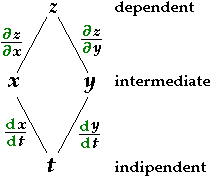 Although the formal proof is not trivial, the variable-dependence
diagram shown here provides a simple way to remember this Chain Rule.
Simply add up the two paths starting at z and ending at t,
multiplying derivatives along each path.
Although the formal proof is not trivial, the variable-dependence
diagram shown here provides a simple way to remember this Chain Rule.
Simply add up the two paths starting at z and ending at t,
multiplying derivatives along each path.
Example
Let z = x2y-y2 where x and y are parametrized as x = t2 and
y = 2t.
Then
|
| |
|
|
|
|
∂z
∂x
|
|
dx
dt
|
+ |
∂z
∂y
|
|
dy
dt
|
|
| |
|
| |
|
|
(2t2·2t)(2t) + ( (t2)2-2(2t) ) (2) |
| |
|
| |
|
|
| |
|
Alternate Solution
We now suppose that x and y are both multivariable functions.
Let x = x(u,v) and y = y(u,v) have first-order partial derivatives at
the point (u,v) and suppose that z = f(x,y) is differentiable at the
point (x(u,v),y(u,v)). Then f(x(u,v),y(u,v)) has first-order
partial derivatives at (u,v) given by
|
| |
|
|
|
|
∂z
∂x
|
|
∂x
∂u
|
+ |
∂z
∂ y
|
|
∂y
∂u
|
|
| |
|
|
∂z
∂x
|
|
∂x
∂v
|
+ |
∂z
∂ y
|
|
∂y
∂v
|
|
|
| |
|
Proof
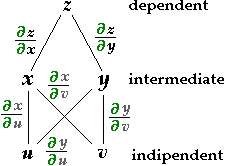 Again, the variable-dependence diagram shown here indicates this Chain
Rule by summing paths for z either to u or to v.
Again, the variable-dependence diagram shown here indicates this Chain
Rule by summing paths for z either to u or to v.
Example
Let z = ex2y, where x(u,v) = √[uv] and y(u,v) = 1/v. Then
|
| |
|
|
|
|
∂z
∂x
|
|
∂x
∂u
|
+ |
∂z
∂y
|
|
∂y
∂u
|
|
| |
|
|
( 2xyex2y ) |


 |
√v
2√u
|

 |
+ (x2ex2y)(0) |
| |
|
|
2 |
| __
√uv
|
· |
1
v
|
e(√[uv])2 · 1/v · |
√v
2√u
|
+ ( |
| __
√uv
|
)2 · e(√[uv])2 ·1/v ·(0) |
| |
|
| |
|
| |
|
|
|
∂z
∂x
|
|
∂x
∂v
|
+ |
∂z
∂y
|
|
∂y
∂v
|
|
| |
|
|
( 2xyex2y ) |
|
√u
2√v
|
|
+ (x2ex2y) |
|
- |
1
v2
|
|
|
| |
|
|
2 |
| __
√uv
|
· |
1
v
|
e(√[uv])2·1/v · |
√u
2√v
|
+ ( |
| __
√uv
|
)2e(√[uv])2 ·1/v · |
|
- |
1
v2
|
|
|
| |
|
| |
|
|
| |
|
Alternate Solution
These Chain Rules generalize to functions of three or more variables
in a straight forward manner.
Key Concepts [index]
- Let x = x(t) and y = y(t) be differentiable at t and suppose that
z = f(x,y) is differentiable at the point (x(t),y(t)). Then
z = f(x(t),y(t)) is differentiable at t and
|
|
dz
dt
|
= |
∂z
∂x
|
|
dx
dt
|
+ |
∂z
∂y
|
|
dy
dt
|
. |
|
- Let x = x(u,v) and y = y(u,v) have first-order partial derivatives at
the point (u,v) and suppose that z = f(x,y) is differentiable at the
point (x(u,v),y(u,v)). Then f(x(u,v),y(u,v)) has first-order
partial derivatives at (u,v) given by
|
| |
|
|
|
|
∂z
∂x
|
|
∂x
∂u
|
+ |
∂z
∂ y
|
|
∂y
∂u
|
|
| |
|
|
∂z
∂x
|
|
∂x
∂v
|
+ |
∂z
∂y
|
|
∂y
∂v
|
|
|
| |
|
|