Computing Limits
Intuitively, we say that limx→ c f(x) = L if f
is defined near (but not necessarily at) c and f(x) approaches L
as x approaches c.
If we let x approach c from the left side only, we write
limx→ c- f(x) since x is approaching c from
smaller values. Similarly, for x approaching c from the right, we
write limx→ c+ f(x). The two-sided
limit limx→ c f(x) exists if and only if both of
these one-sided limits exist and they are equal.
An Intuitive Example
Consider the graph of a function f(x) shown below.
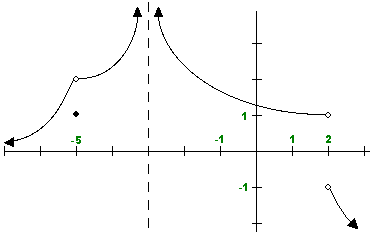
Evaluate each of the following. Select (click) each one to check your
reasoning.
Definition of the Limit
More rigorously, let f be defined at all x in an open interval
containing c, except possibly at c itself.
Then
if and only if for each ε > 0, there exists a
δ > 0 such that
| if 0 <
|x-c| <
δ then
|f(x)-L| <
ε.
|
|
In words, limx→ c f(x) = L if and only if by
taking x close enough to c (but different from c: see c = −5 in the preceding example) we can get f(x) arbitrarily close to L.
animazione (← clicca)
Properties of the Limit
Each of the following properties is proven using the rigorous
definition of the limit. Let lim stand for limx→ c, limx→ c+, or limx→ c-. Assume lim f(x) and lim g(x) both exist.
- (Uniqueness) If lim f(x) = L1 and lim f(x) = L2, then L1 = L2.
- (Addition) lim [f(x)+g(x)] = lim f(x) +lim g(x).
- (Scalar multiplication) lim [αf(x)] = αlim f(x).
- (Multiplication) lim [f(x)g(x)] = lim f(x) · lim g(x).
- (Division) lim [f(x)/ g(x)] = lim f(x) / lim g(x), provided lim g(x) ≠ 0.
- (Powers) lim [f(x)]n = [lim f(x)]n
for any positive integer n.
In practice, much of the time we can ``reason out'' the value of a
limit without explicitly using the ε-δ definition.
Examples
- limx→ 2 √(x2+12) = 4 since the function
f(x) = √(x2+12) is continuous at x = 2 and f(2) = 4.
- limx→ ∞ 1/x = 0 since as x increases, 1/x gets arbitrarily close to 0.
- limx→ 0+ ln|x| tends to -∞ and so does not exist since as x decreases to 0, ln|x| gets arbitrarily large in magnitude and negative.
- limx→ 3 [(x2-9)/( x-3)] = 6 even though f(x) = (x2-9)/( x-3) is undefined at x = 3 since (x2-9)/( x-3) = x+3 and limx→ 3x+3 = 6.
What about something like limx→ 0 [sin x / x]? When we cannot easily ``reason out'' the value of a limit, we can often use numerical methods or L'Hôpital's Rule to determine the value of the limit. Can you convince yourself that limx→ 0 [sin x / x] = 1?